This Day in History: October 17, From Saratoga to the Paris Demonstrations
This date marks Burgoyne’s 1777 surrender at Saratoga, alongside milestones in communications, politics, energy and culture.
This Day in History: October 17, 2026
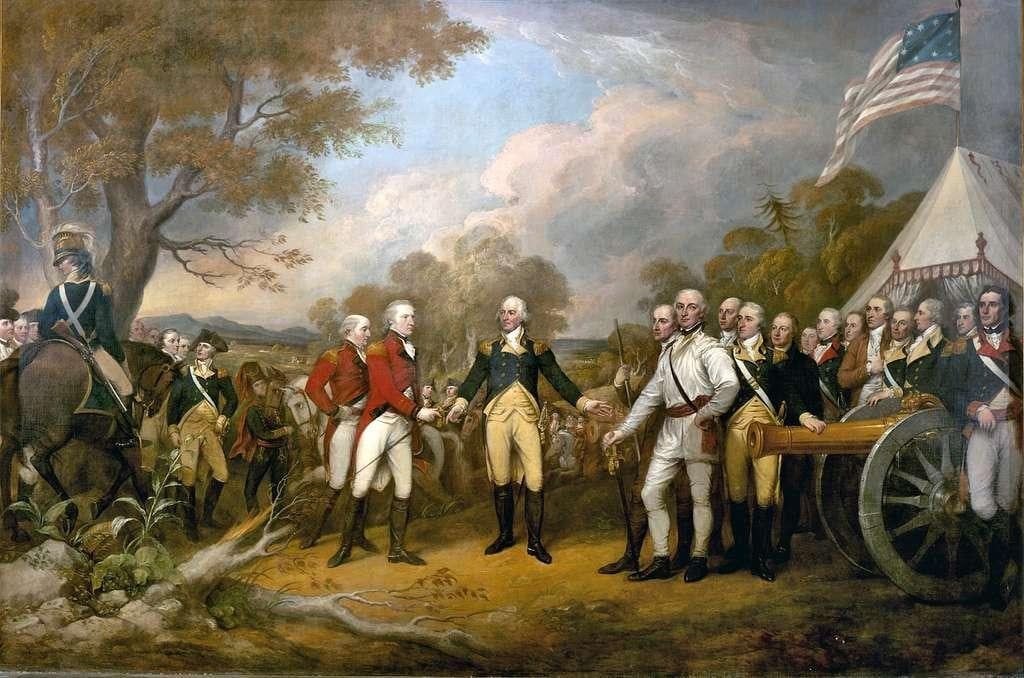
On October 17, 1777, British General John Burgoyne surrendered his army at Saratoga, New York, giving the American Revolution a turning point with consequences far beyond North America. The victory helped convince France that the Americans could win and encouraged it to enter a formal alliance with them. French military and financial support later proved essential to American independence. Saratoga remains significant because it helped turn a colonial rebellion into a wider international conflict and changed the balance of power across the Atlantic.
Get The Latest News!
Don't miss our top stories and need-to-know news everyday in your inbox.
The anniversary also brings together stories of technological progress, struggles over political rights, and people whose work crossed national boundaries. Following those events through time shows how one calendar date can connect very different parts of the human experience.
Major Historical Events
1346: Scotland’s king is captured at Neville’s Cross
Near Durham in northern England, an English army defeated Scottish forces at the Battle of Neville’s Cross on October 17, 1346. Scotland’s King David II had invaded England while Edward III was campaigning in France. The invasion supported Scotland’s alliance with France during the Hundred Years’ War.
David was captured and remained an English prisoner until 1357, when a ransom agreement secured his release. His long absence complicated Scottish government and placed a lasting financial burden on the kingdom. The battle also illustrates how wars between England and France repeatedly drew neighboring countries into a wider contest.
1777: The surrender at Saratoga changes the American Revolution
More than four centuries later, another British military campaign ended in a surrender. Burgoyne had advanced south from Canada, hoping to gain control of the Hudson River corridor and separate New England from the other rebellious colonies. Supply problems, difficult terrain, and growing American resistance undermined the plan.
After fighting near Saratoga in September and October, his army was surrounded. Burgoyne surrendered to American General Horatio Gates on October 17.
France had already been supplying aid to the Americans, but Saratoga strengthened the case for open intervention. The Franco-American treaties of 1778 brought an alliance that expanded the war’s reach and forced Britain to defend interests across several regions.
1907: Commercial wireless service crosses the Atlantic
A regular commercial transatlantic wireless telegraph service opened between Marconi stations at Clifden, Ireland, and Glace Bay, Nova Scotia, on October 17, 1907. Instead of relying on an undersea cable, messages traveled by radio.
Wireless communication was not yet as dependable as established cable networks, and the service faced technical difficulties. Even so, its opening marked an important step toward practical long-distance radio communication. The same developing technology would become vital to shipping, emergency signals, broadcasting, and international news.
1945: Mass demonstrations reshape Argentine politics
Crowds gathered in Buenos Aires on October 17, 1945, demanding the release of Juan Domingo Perón, a military officer and former labor secretary who had recently been detained amid a struggle within the government.
Perón had gained support among workers through labor policies and his relationships with unions. The demonstrations helped secure his release and demonstrated the strength of his political following. He won the presidency the following year.
Remembered by Peronists as Loyalty Day, October 17 became central to the movement’s identity. Peronism has remained a major force in Argentina, although its policies and leadership have changed substantially over time.
1961: Paris police violently suppress an Algerian demonstration
During the Algerian War, thousands of Algerians demonstrated in Paris on October 17, 1961, against a discriminatory nighttime curfew. The protest was organized by the French branch of the National Liberation Front, which was fighting for Algerian independence.
Police violently suppressed the demonstration. Protesters were beaten, thousands were detained, and people were killed; some victims were thrown into the Seine. The exact death toll remains disputed, and official accounts initially concealed much of the violence.
The killings later became an important subject of historical investigation and public acknowledgment in France. They show how the conflict over Algeria extended beyond North Africa into metropolitan France.
1973: Arab oil producers announce production cuts
On October 17, 1973, Arab oil-producing states agreed to reduce oil production during the Arab-Israeli war that had begun earlier that month. The cuts were followed by selective embargoes, including an embargo against the United States announced on October 19.
These measures, combined with other pressures in the oil market, contributed to steep price increases and shortages. Import-dependent countries faced inflation, economic disruption, and questions about the security of their energy supplies.
The crisis encouraged energy conservation, strategic petroleum reserves, and efforts to diversify fuel sources. It also demonstrated how decisions by oil-producing countries could affect daily life and economic policy around the world.
2003: UNESCO adopts a convention protecting living heritage
UNESCO adopted the Convention for the Safeguarding of the Intangible Cultural Heritage on October 17, 2003. The agreement focused on traditions such as oral storytelling, performing arts, rituals, and craft knowledge.
Unlike monuments or archaeological sites, these forms of heritage depend on people continuing to practice and pass them on. The convention encouraged countries to work with communities to safeguard that knowledge. It broadened international preservation efforts beyond buildings and objects to include living cultural practices.
Notable Births
Chiquinha Gonzaga — 1847
Born in Rio de Janeiro, Chiquinha Gonzaga became an influential Brazilian composer, pianist, and conductor. Her music helped shape Brazilian popular theater and musical culture. She also supported abolition and challenged restrictions on women’s professional lives, leaving a legacy in both music and public life.
Arthur Miller — 1915
American playwright Arthur Miller explored family expectations, personal responsibility, and social pressure. Works including Death of a Salesman and The Crucible became widely performed internationally. His plays continue to invite discussion about how people respond when private loyalties collide with public demands.
Mae Jemison — 1956
Physician and astronaut Mae Jemison became the first Black woman to travel into space when she flew aboard the space shuttle Endeavour in 1992. Her career has also included medical work and science education, linking space exploration with wider efforts to expand scientific opportunity.
Kimi Räikkönen — 1979
Finnish racing driver Kimi Räikkönen won the Formula One world championship with Ferrari in 2007. His long career included success with several teams and made him one of Finland’s best-known international athletes.
Notable Deaths
Jean-Jacques Dessalines — 1806
A leader of the Haitian Revolution and independent Haiti’s first ruler, Dessalines was assassinated on October 17, 1806. He helped defeat French forces and declared independence in 1804. His legacy includes both Haiti’s founding after a revolution against slavery and the severe violence associated with his rule.
Frédéric Chopin — 1849
Polish composer and pianist Frédéric Chopin died in Paris at age 39. His works expanded the piano’s expressive possibilities, while his mazurkas and polonaises drew on Polish musical traditions. His music remains central to concert performance and piano study.
Santiago Ramón y Cajal — 1934
Spanish scientist Santiago Ramón y Cajal helped establish that the nervous system consists of individual cells rather than one continuous network. His microscopic studies and detailed drawings transformed neuroscience. He shared the 1906 Nobel Prize in Physiology or Medicine with Camillo Golgi.
Across these anniversaries, change takes many forms: a military surrender, a demand for political recognition, a new communication system, or a work of music.
More like this:



- Most Popular


- Top Stories

- Most Recent